

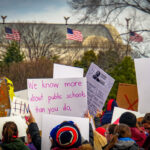
In June 2024, Louisiana Gov. Jeff Landry signed a law requiring Ten Commandments displays in that state’s public classrooms. At a press event the same day, Landry said, “If you want to respect the rule of law, you’ve got to start from the original lawgiver, which was Moses.”
Critics say the law contradicts long-standing United States Supreme Court precedents. Those precedents include the 1980 Stone v. Graham decision, when SCOTUS ruled that a Kentucky law requiring a copy of the Ten Commandments in the state’s public classrooms was an unconstitutional violation of the First Amendment’s establishment clause, which states that “Congress shall make no law respecting an establishment of religion.”
Also in June, Oklahoma’s top education official ordered public schools there to incorporate the Bible into lessons, while the Oklahoma Supreme Court ruled unconstitutional what would have been the nation’s first state-funded Catholic charter school. Later, in November, Texas’ State Board of Education allowed Bible-infused teachings in elementary schools. Officials in other states have also been under pressure to introduce Bible lessons into state education curricula or to ban books and subjects related to race, sexual orientation and gender identification. Meanwhile, the case over whether an effort to establish the first taxpayer-funded charter school in Oklahoma can go ahead is headed to the Supreme Court.
Such moves have outraged civil rights and minority faith and values groups, such as Interfaith Alliance or the Freedom From Religion Foundation, which is part of a coalition suing Louisiana over its Ten Commandments law and which has taken action to block Bible lessons in Oklahoma.
Though there is no U.S. federal law stopping public schools from including the Bible as part of children’s education — and the federal government, in turn, cannot mandate what states teach — opponents fear such initiatives not only violate the Constitution but are “part of a larger push to increase the presence of Christianity in the public sphere and to challenge constitutional protections for religious freedom.”
In this edition of ReligionLink, we share relevant stories, sources and resources to help you report on the separation of church and state as it relates to education, Christian nationalism and parental rights in the U.S.
Background and resources
Efforts to introduce Christian Bible lessons in public schools and require teachers to post the Ten Commandments in their classrooms come as President Donald Trump’s second term begins and the U.S. Supreme Court will decide on a case with ramifications for the interpretation of law under the First Amendment’s establishment clause.
On the campaign trail, Trump pledged to champion prayer and Bible reading in schools, practices already protected by the First Amendment — so long as they are not government-sponsored. Trump and his fellow Republicans also support nationalizing school choice and hope to expand the use of taxpayer-funded vouchers by parents looking to send their children to religious schools. That implicit — and explicit — support may embolden state-level activists looking to advance the place of conservative religious viewpoints in public schools.
It has been 63 years since the landmark Supreme Court case Engel v. Vitale (1962) struck down school-sponsored prayer. But as the above instances show, the fight over the place of religion in U.S. public schools is far from over and the issue remains an important battleground in the broader conflict over religion’s role in public life.
In January, the Supreme Court agreed to hear arguments over whether Oklahoma officials can approve the nation’s first publicly funded religious charter school. The justices will hear disputes from both sides in Oklahoma Statewide Virtual Charter School Board v. Drummond and St. Isidore of Seville Catholic Virtual School v. Drummond, deciding whether the proposed St. Isidore of Seville Catholic Virtual School, which would be an online-based charter school, violates state and federal constitutions. They have already shown a willingness to overturn precedent and re-interpret the establishment clause in decisions such as in Kennedy v. Bremerton School District.
*Culture wars renewed: 25 sources + resources*
On the one hand, some decry what they see as an effort to push religion out of schools, which they believe infringes their First Amendment rights. These concerns have also been positioned within the broader parental rights movement, which aims at restricting schools’ ability to teach certain viewpoints on gender, sexuality or race without parental consent or opt-outs.
On the other hand, critics are troubled by what they see as the imposition of a particular brand of conservative Christianity through public institutions. They see efforts in Louisiana, Oklahoma and Texas contradicting the separation between church and state and, for other Christians, religious minorities or the nonreligious, the limitation of their own free expression. All of this, as the push for parental rights has threatened long-held institutional protections for teachers (e.g., teacher tenure) and the existence of the Department of Education itself.
Very few argue that theology and doctrine cannot be taught at private schools or that teachers at such schools cannot lead students in prayer. But there are concerns about student tuitions at such schools being subsidized through taxpayer-funded vouchers.
All the while, the practice of religion — wearing religious clothing, prayer at lunchtime or even the teaching of “religion” as a secular subject in social studies or literature classrooms — is quite banal in public institutions. A 2019 survey of American teens shows some forms of religious expression are relatively common in public schools, with about half of U.S. teens in public schools (53%) saying they often or sometimes see other students wearing jewelry or clothing with religious symbols. And about 4 in 10 say they routinely see other students praying before sporting events.
For more background, read some of the sources below:
- Read “Can Louisiana require the Ten Commandments in classrooms?” from Harvard Law Today.
- Read “Religious Liberty in American Higher Education,” from the Religious Freedom Institute.
- Read “Religion and public schools,” from the American Civil Liberties Union.
- Read “Kennedy v. Bremerton: The Wall Separating Church and State Just Got a Little Shorter,” from The Canopy Forum.
- Read “Religion in the public schools,” from the Pew Research Center.
Related news and commentary
- Read “Supreme Court to decide whether states can allow religious public schools,” from The Washington Post on Jan. 24, 2025.
- Watch “Supreme Court to hear church-state fight over bid to launch first publicly funded religious charter school,” from NBC News on Jan. 24, 2025.
- Read “Some US lawmakers want more Christianity in the classroom. Trump could embolden their plans,” from The Associated Press on Jan. 11, 2025.
- Read “Maine religious schools ask appeals court to halt state’s anti-discrimination rules,” from the Portland Press Herald on Jan. 7, 2025.
- Read “Ohio could mandate public schools to allow third-party religious ed during school day,” from Religion News Service on Dec. 13, 2024.
- Read “Reading, writing, and the Ten Commandments? Why some public schools teach the Bible,” from The Christian Science Monitor on Dec. 4, 2024.
- Read “With Trump’s return comes a chance for parents to opt for religious schools,” from RNS on Nov. 29, 2024 (Commentary).
- Read “You don’t need to panic about Bibles in public schools,” from MSNBC on Nov. 23, 2024.
- Read “Texas proposal would give schools the option to use Bible teachings in lessons,” from The Associated Press on Nov. 19, 2024.
- Read “In Close Vote, Texas Approves Reading Program Laden With Bible Lessons,” from The 74 on Nov. 19, 2024.
- Read “Oklahoma superintendent spars with CNN host over Bibles in schools: Liberals ‘don’t have to like it’” from Fox News on Nov. 18, 2024.
- Read “Texas education board to vote on Bible-infused in public schools,” from The New York Times on Nov. 18, 2024.
- Read “Ohio offers a new way to use public money for Christian schools. Opponents say it’s unconstitutional,” from The Associated Press on Nov. 17, 2024.
- Read “Trump wants prayer in schools. The Bible tells us how dangerous that is,” from the Forward on Nov. 16, 2024 (Commentary).
- Read “Takeaways from AP’s report on churches starting schools in voucher states,” from The Associated Press on Sept. 20, 2024.
- Read “Republicans advocating for more Christianity in public schools face pushback,” from Fox News on Sept. 5, 2024.
- Read “Why mandating biblical texts in public schools may backfire,” from RNS on July 25, 2024 (Commentary).
- Read “Bills to enhance religion in schools spur fights between faiths,” from RNS on July 5, 2024.
- Read “What to know about Oklahoma’s top education official ordering Bible instruction in schools,” from The Associated Press on June 28, 2024.
- Read “Oklahoma schools now required to teach Bible, Ten Commandments: superintendent,” from Fox News on June 27, 2024.
- Read “Lawsuit alleges religious coercion through meditation in Chicago Public Schools,” from RNS on May 13, 2024.
Relevant sources
-
Alliance Defending Freedom
The Alliance Defending Freedom is a watchdog group that was founded by Bill Bright, the evangelical minister who started Campus Crusade for Christ, and several other evangelical leaders. It concerns itself with three main issues: religious liberty, “sanctity of life” and traditional marriage. It is based in Scottsdale, Arizona, and Kristen Waggoner is CEO, president and general counsel. Use the website for media.
-
American Civil Liberties Union
The ACLU addresses hate speech in its work on free speech, religion, LGBT rights, human rights and racial justice.
-
American Jewish Committee
The American Jewish Committee is an international think tank and advocacy organization that works to identify and fight antisemitism and bigotry, protect human rights and protect Israel and Jewish life everywhere. Its executive director is Ted Deutch. Contact via Jon Schweitzer, managing director of marketing and communications.
-
Baptist Joint Committee for Religious Liberty
The Baptist Joint Committee for Religious Liberty is an umbrella organization of 15 Baptist bodies that work to promote religious liberty. They advise member denominations on religious liberties issues. It is based in Washington, D.C. Its executive director is Amanda Tyler, with J. Brent Walker serving as a consultant to the organization.
-
Derek Black
Derek Black is a law professor at the University of South Carolina and an expert in education policy. Black wrote Schoolhouse Burning: Public Education and the Assault on American Democracy.
-
Mary Anne Case
Mary Anne Case is a law professor at the University of Chicago. She teaches on a variety of legal topics, including sexual discrimination, religious freedom, constitutional law and feminist jurisprudence.
-
Center for Education Policy Research
The Center for Education Policy Research at Harvard University generates research for the education field, develops technical and organizational capacity within education agencies and convenes a network of schools and systems dedicated to using evidence for educational progress. Christina Grant is executive director.
-
Joshua Cowen
Joshua Cowen is an associate professor of education at Michigan State University in East Lansing and an expert on school vouchers and charter schools.
-
Robert C. Enlow
Robert C. Enlow is the president and CEO of EdChoice, a nonprofit that supports school choice.
-
Freedom From Religion Foundation
The Freedom From Religion Foundation is based in Madison, Wisconsin, and has become one of the leading activist groups on the nontheist scene.
-
Richard Garnett
Richard Garnett is a professor of law and political science at the University of Notre Dame. He is an expert on the Supreme Court, church-state issues, religious liberty and Catholic social thought.
-
Ursula Hackett
Ursula Hackett is a senior lecturer in politics at Royal Holloway, University of London. Hackett is the author of America’s Voucher Politics: How Elites Learned to Hide the State.
-
Paul Horwitz
Paul Horwitz is a professor of law at the University of Alabama in Tuscaloosa, where he specializes in law and religion, constitutional law and the First Amendment. He is the author of The Agnostic Age: Law, Religion and the Constitution and First Amendment Institutions.
-
Rachel Laser
Rachel Laser is the president and CEO of Americans United for Separation of Church and State, an advocacy organization that seeks to reduce entanglement between the government and faith groups. She previously served as deputy director of the Religious Action Center of Reform Judaism, where she worked on social justice issues, including gun control, abortion rights and reproductive rights. Arrange an interview through Liz Hayes.
-
Christopher Lubienski
Christopher Lubienski is a professor of education at Indiana University in Bloomington. He is an expert on school choice and vouchers and the battle over them between religious group and secular groups. Contact via Steve Hinnefeld, news and media specialist.
-
Lutheran Education Association
The Lutheran Education Association is a national network of Lutheran educators, which trains, assists and offers support to its members through conferences and other resources. Jonathan Laabs is executive director.
-
National Catholic Educational Association
The National Catholic Educational Association works with Catholic educators to support ongoing faith formation and the teaching mission of the Catholic Church. Its membership includes nearly 140,000 educators serving 1.6 million students in Catholic education. Steven Cheeseman is the NCEA president/CEO. BeeJae Visitacion is director of communications.
-
Asra Q. Nomani
Asra Nomani is an Indian American journalist and Federalist contributor, who — among other things — is outspoken in opposing critical race theory and gender diversity in education, which she has described as divisive ideologies.
-
Religious Freedom Institute
The Religious Freedom Institute advocates for religious freedom in the United States and abroad. RFI produces research and educational programs and maintains five regional action teams that lobby governments and civil leaders to protect religious freedom globally.
-
Mark Satta
Mark Satta is a professor of philosophy at Wayne State University. He focuses on epistemology, philosophy of language and philosophy of law.
-
The Secular Student Alliance
The Secular Student Alliance is based in Minneapolis and describes itself as “an umbrella organization uniting atheist, agnostic, humanist, rationalist, skeptic, and freethought students and groups on high school and campuses across the world.” The SSA has a list of affiliates around the country and the world.
-
Claire Smrekar
Claire Smrekar is an associate professor of public policy and education at Vanderbilt University. Her research includes studying the effects of private school markets and demographic trends on school voucher plans.
-
Katherine Stewart
Katherine Stewart is the author of The Good News Club: The Christian Right’s Stealth Assault on America’s Children, a look at religious fundamentalism’s influence on public education (2012), as well as The Power Worshippers: Inside the Dangerous Rise of Religious Nationalism (2020) and Money, Lies, and God: Inside the Movement to Destroy American Democracy (2025).
-
Matthew D. Taylor
Matthew D. Taylor is a senior scholar at the Institute for Islamic, Christian and Jewish Studies, where he specializes in Muslim-Christian dialogue, evangelical and Pentecostal movements, religious politics in the U.S. and American Islam. Media inquiries should be directed to ICJS’ communications and marketing director, John Rivera.
-
United States Conference of Catholic Bishops
The United States Conference of Catholic Bishops is an organization that works “to unify, coordinate, encourage, promote and carry on Catholic activities in the United States.”
-
Nathan C. Walker
Nathan C. Walker is president of 1791 Delegates, a public charity named after the year the Bill of Rights was ratified. He regularly writes about freedom of religion or belief in the U.S. and international contexts. Walker is a Unitarian Universalist minister and received his Master of Divinity degree in religion and education from Union Theological Seminary in New York City. In 2024, he was awarded a Chancellor’s Grant for Pedagogical Innovation to develop the course AI Ethics & Law for Rutgers Honors College, loosely based on his book Moral Compass: Principled AI Leadership. He has also been invited to serve as a visiting researcher at Oxford University’s Institute for Ethics in AI.
-
Randi Weingarten
Randi Weingarten is president of the American Federation of Teachers.