


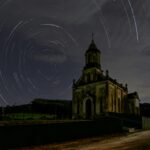
Picture outer space. Its seemingly endless reach, its pulsating planets and twinkling stars, the swirling canopy of galaxies, a mantle of nebulae, the curvature of Earth’s blue expanse from a vantage point miles away.
Absorbing yourself in these images, what do you feel?
Some might compare the impulse to awe when we picture outer space or see images beamed back from faraway satellites to religious epiphany or other forms of spiritual inspiration.
From astrology to astrotheology, from questions of how to practice religions ensconced in Earth’s realities and rhythms to the context of outer space or life on other planets to the creation of new traditions, spirituality and space exploration are more intertwined than you may think.
In this edition of ReligionLink, we explore the intersections between religion and space, offering background, relevant stories and expert sources to help you report on religious traditions boldly going where no religions have gone before.
Background
Humans have long been drawn to space as part of our search for meaning, significance and security.
Astrology originated in ancient Mesopotamia before spreading to various regions and cultures, perhaps most notably in the Hellenistic period in Greece and later in Islamic and European cultures. It initially was a form of divination, with early astrologers using celestial events to interpret omens from the gods and predict the future.
Over time, astrology developed in different directions, with horoscope columns coming to feature in daily newspapers starting in the 1930s.
Today, astrology has been experiencing a bit of a renaissance, with many among the spiritual-but-not-religious seeking to discern meaning and purpose by studying the positions of celestial objects.
Stars have held varying levels of significance in various religious traditions. A star is supposed to have guided “wise men from the East” to the first Nativity; and both the Hebrew Scriptures and Christian New Testament bear references to the stars providing divine guidance and revelation. Finno-Ugric and Turkish Tatars associated the North Star (Polaris) with the “pillar of heaven,” while the Milky Way has been seen as a symbol of a cosmic tree or the path of the gods.
In Judaism, the Star of David, or six-pointed star, is a prominent symbol representing the union of heaven and earth and is a rallying marker of protection, identity and unity. In Buddhism, stars can be seen as celestial luminaries, and in Hindu scriptures, the stars are often depicted as the abode of gods and goddesses, symbolizing enlightenment and the eternal nature of the soul.
More recently, the relationship between religious traditions and space is evolving — for example, as more Muslim-majority nations venture into space exploration, writes Béatrice Hainaut. The first Muslim in space was in 1985, and to date, 18 Muslim astronauts have traveled beyond Earth’s orbit. But over the last 10 years, countries such as Bahrain, the United Arab Emirates and Saudi Arabia have established space agencies and expressed ambitious space strategies. Other states, including Iran, Turkey, Malaysia, Indonesia and Pakistan, are also showing interest in space research and possible applications derived from it.
It is perhaps the new religious movement Astronism, however, that has taken the relationship between astronomy and religion to its logical limit. At the age of 15, Brandon Reece Taylorian, also widely known under his mononym Cometan, founded Astronism, an astronomical religion that “teaches that outer space should become the central element of our practical, spiritual, and contemplative lives,” according to its website.
“From my perspective, how religion and outer space intersect is crucial to understanding the future of religion,” Cometan, who is also a lecturer at Lancaster University in the United Kingdom, told ReligionLink. “Outer space is the next great frontier that will reshape the human condition, including our religions.”
To that end, some have started to ponder how space exploration itself might be considered its own form of epiphanic religion, producing its own forms of insight, revelation and spiritual experience.
That makes sense to Cometan. “The further we dare to venture beyond Earth, the more our beliefs about God and the universe will transform. I think that we need new and bold religious systems that will inspire our species to confront and overcome the challenges of the next frontier,” he said. “As an Astronist, I define outer space as the supreme medium through which the traditional questions of religion will be answered.”
Whether Cometan proves to be correct, stars have been interpreted in diverse ways across religious traditions, reflecting the human desire to understand and connect with the divine through the wonders of the cosmos.
For more on religion and the stars, check out these perspectives and thought pieces:
- Read “Exploring space: ethical dilemmas for Catholicism,” from Frontiers (2025).
- Read “Astronism, Cosmism and Cosmodeism: An Analysis of the Space Religions espousing Transcension,” from SSRN (2024).
- Read “The Future of Religion as Humans Expand into Space,” from Theology & Science (2024).
- Listen to “Is Human Spaceflight a Religion?” from Planetary Radio (2024).
- Read “Buddhists Do Not Want Space Junk to Fall on Your Head,” from E-International Relations (2023).
- Read “The Intersection of Religion and Space Exploration,” from New Space Economy (2023).
- Watch “Stories and the Stars: How beliefs, stories and rituals may inform a positive space future,” from the Arizona State University Interplanetary Initiative (2022).
- Read “Religion in space: A sense of divine entitlement pervades private space colonization efforts,” from Science (2022).
- Read “Muslims in Outer Space,” from Harvard Divinity School (2018).
- Read “The Separation of Church and Space,” from the University of Dayton Magazine (2018).
- Read “The Holy Cosmos: The New Religion of Space Exploration,” from The Atlantic (2012).
Tips & Suggestions
Reporting on religion and space exploration opens up numerous angles for reporting, analysis and commentary, including:
- Thinking through the practical, material challenges and opportunities offered by adapting religious rituals for zero gravity or extraterrestrial environments.
- Exploring the ways religion and spirituality have been depicted in space-related pop culture or science fiction.
- Analyzing the ethical considerations at play in extraterrestrial encounters, the privatized space race or the colonization of other planets.
- Contextualizing humans’ contemporary fascination with space in religious traditions ancient texts and their own readings of the stars.
- Seeing how religious communities are caring for, or calling on, their parishioners, members or practitioners who are involved in space exploration and related technologies.
Relevant newswriting
2025
- Read “Nearly 1 in 3 Americans consult astrology, tarot cards or a fortune teller, Pew study finds,” from Religion News Service on May 21, 2025.
- Read “Do aliens keep kosher? Judaism and the possibility of life beyond Earth,” from The Jerusalem Post on April 5, 2025.
- Read “What it’s like to attend church in space,” from Deseret News on April 1, 2025.
- Listen “A Ross Douthat Guide to Fairies, UFOs … and Church,” from Religion News Service on March 27, 2025.
- Read “Could a star-bathing retreat help calm your frazzled mind?” from the BBC on March 26, 2025.
- Read “How Sunita Williams Took Indian Culture to Space,” from The Times of India on March 14, 2025.
- Read “The Impossible Collection: Space-Flown Religious Objects Outside my Grasp,” from Collecting Religion on Feb. 3, 2025 (Analysis).
- Read “Jews in Space?” from Mishpacha on Jan. 16, 2025.
2024
- Read “Gazing At The Heavens: The Vatican Observatory’s Mission To Study Faith And Science,” from Religion Unplugged on Nov. 8, 2024.
- Read “Tracing the Bible’s History Through Time and Space,” from Christianity Today in October 2024 (Review).
- Read “When the Elder Calls—From Outer Space,” from Christianity Today on Oct. 14, 2024.
- Read “Awe in the Age of Distraction – Space Travel and Spiritual Growth,” from Buddhist Door Global on Sept. 21, 2024 (Commentary).
- Read “Astronomers discover oldest known eclipse reference in 6,000-year-old Hindu text,” from Life Science on Sept. 5, 2024.
- Read “One church, two astronauts. How a Texas congregation is supporting its members on the space station,” from The Associated Press on Aug. 4, 2024.
- Read “Space Force Hymn Writer Inspired By ‘Awe And Wonder Of God’” from Religion Unplugged on July 4, 2024.
- Read “Space, Time, Religion: How Einstein’s Insights Give Us Perspective of God,” from Spectrum on June 24, 2024 (Analysis).
- Read “NASA wants to create a time zone on the moon. Here’s what that means for Jewish space travelers,” from the Forward on May 1, 2024.
2022-2023
- Read “Astrologers respond as Starbucks becomes latest brand to look to the stars,” from Religion News Service on March 30, 2023.
- Read “Space travel will radically change human psychology and spirituality,” from Big Think on Feb. 3, 2023 (Analysis).
- Read “How should Christians feel about the new images of outer space?” from Deseret News on Aug. 10, 2022.
- Read “Nazi-Acquired Buddha Statue Came From Space,” from Live Science on July 28, 2022.
- Read “Passover in Space: Brevard rabbi delivers special matzah to Israeli astronaut in time for holiday,” from USA Today on April 13, 2022.
- Read “Is There a Place For Spirituality in Space Science?” from Undark on Jan. 27, 2022 (Commentary).
2021 and before
- Read “How to practice religion could be a big question for some space tourists,” from CNN on Sept. 15, 2021.
- Read “For atheists, the idea of aliens seems real. Religious people doubt it,” from Religion News Service on Aug. 23, 2021.
- Read “Kyoto Temple Plans Outer Space Location,” from Tricycle in Summer 2021.
- Read “David J. Halperin on why UFOs tell us more about life on Earth than outer space,” from Religion News Service on April 17, 2020.
- Read “Religion and Rocketry: How German Theology and Russian Mysticism Shape Our View of Outer Space,” from Reactor Magazine on Nov. 27, 2018.
Experts and sources
-
Joshua D. Ambrosius
Joshua D. Ambrosius is a professor at the University of Dayton. He regularly teaches courses related to urban housing and faith-based social policy and innovative, interdisciplinary approaches to space exploration.
-
Philip Butler
Philip Butler is a professor at Iliff School of Theology in Denver. Butler’s work focuses on the intersections of neuroscience, technology, spirituality and Blackness. He engages in critical and constructive analysis on Black posthumanism, artificial intelligence and pluriversal future realities.
-
Cometan
Cometan, also known as Brandon Reece Taylorian, is an associate lecturer in the Lancaster University Law School and an associate lecturer at the University of Central Lancashire, where he teaches on the program Religion, Culture and Society. His research interests include freedom of religion or belief, new religious movements, traditionalist Catholicism and the relationship between astronomy and religion. At 15, Cometan founded his own religion, called Astronism.
-
Andrew Davison
Andrew Davison is Regius Professor of Divinity at Christ Church College at the University of Oxford. His work spans Christian doctrine, natural science and philosophy. Recently, that has taken in life elsewhere in the universe, but also an application of medieval accounts of analogy to help think about what we mean when we attribute humanlike capacities to machine learning or artificial intelligence.
-
Brian Green
Brian Green is the director of technology ethics at the Markkula Center for Applied Ethics at Santa Clara University. He studies how emerging technologies, including artificial intelligence, affect human life.
-
Jaimie Gunderson
Jaimie Gunderson is a religious studies professor at the University of Pittsburgh, whose research interests include Christian origins, Christianity in late antiquity, New Testament, Greco-Roman religions, material religion, affect theory and UFOs.
-
Béatrice Hainaut
Béatrice Hainaut is a researcher on space issues for the Institute for Strategic Research, Paris. Her work has focused on the emergence and promotion of behavioral norms relating to the safety of space activities, including religion and spirituality.
-
Catherine Hezser
Catherine Hezser is a professor of Jewish studies at SOAS in London. Hezser has examined the ways in which ancient Jews and Christians imagined outer space, the heavens and their occupants and space travel, distinguishing between but also linking this world to another, higher sphere.
-
David W. Kim
David W. Kim is a researcher associated with the Australian National University’s Institute for Space. His research focuses on safety and risk management for astronauts in deep space travel, specifically on psychological well-being during Mars missions.
-
Roger D. Launius
Roger D. Launius is former chief historian of NASA and most recently associate director for collections and curatorial affairs at the Smithsonian Institution’s National Air and Space Museum. He now runs his own private historical consultancy and has written on religion and space.
-
Eric Michael Mazur
Eric Michael Mazur is a religion professor at Virginia Wesleyan College in Norfolk, where he teaches courses on religion and popular culture and Judaism and film. He is the editor of the Encyclopedia of Religion and Film. He is also co-editor of Religion and Outer Space, a volume exploring religion in and on the final frontier.
-
Catherine L. Newell
Catherine L. Newell is associate professor of religion and science at the University of Miami. Newell is a scholar of the conjoined histories of religion and science (specifically technology, ecology and medicine). She is particularly interested in how scientific paradigms frequently owe their genesis to a religious idea or spiritual belief.
-
Mary-Jane Rubenstein
Mary-Jane Rubenstein writes about the mythological assumptions beneath contemporary science and philosophy. She teaches religion and science studies at Wesleyan University and is the author of Astrotopia: The Dangerous Religion of the Corporate Space Race.
-
Sarah McFarland Taylor
Sarah McFarland Taylor is an associate professor of religion at Northwestern University in Evanston, Illinois. She is the author of Green Sisters: A Spiritual Ecology, about the growing number and strength of environmentally activist Roman Catholic nuns. She is co-editor of Religion and Outer Space, a volume exploring religion in and on the final frontier. She has also written about creation spirituality; the Gaian, or Earth-based, Mass; the idea of the eco-church; and the general “greening” of religion in America.
-
Vatican Observatory
The Vatican Observatory (Specola Vaticana) is an astronomical research and educational institution supported by the Vatican. Originally based in Rome, the Observatory is now headquartered in Castel Gandolfo, Italy, and at the Mount Graham International Observatory in the Pinaleño Mountains in southeast Arizona. Journalists can contact via the email here or direct questions to individual members of staff.
-
Deana Weibel
Deana Weibel is an anthropology professor at Grand Valley State University in Michigan. She has performed research in the French shrine towns of Lourdes and Rocamadour, on veneration of Black Madonnas, pilgrimage to space and the competition between pilgrimage and tourism.
-
Benjamin Zeller
Benjamin Zeller is chair of the religion department at Lake Forest College. He focuses on religious currents that are new or alternative, including new religions, the religious engagement with science, and the quasi-religious relationship people have with food.