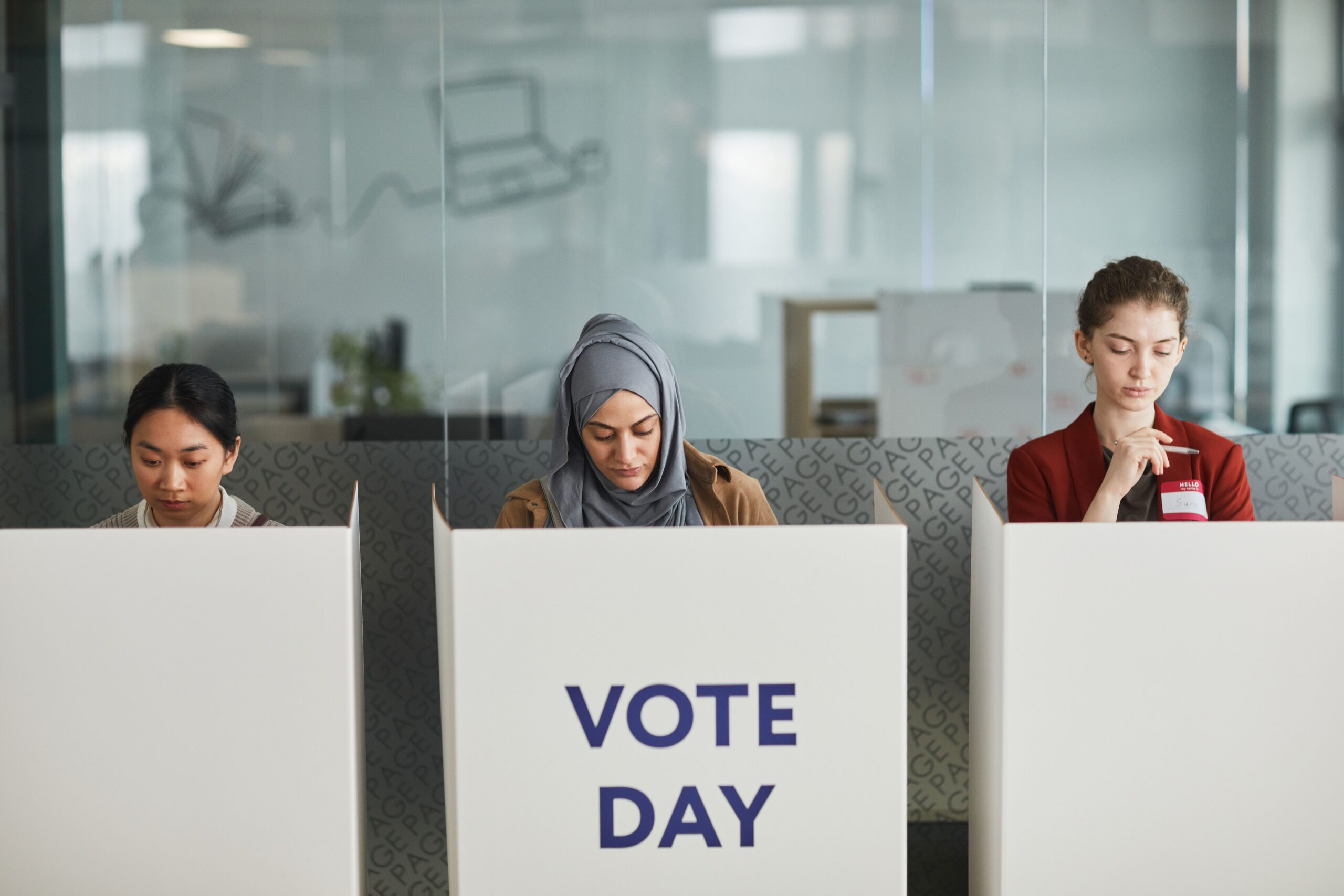
Five faith stories for after the midterms
In this guide, we break down five storylines to explore how religion shapes—and is shaped by—the political landscape in the months ahead.
 Afrikaans
 Albanian
 Arabic
 Armenian
 Azerbaijani
 Basque
 Belarusian
 Bulgarian
 Catalan
 Chinese (Simplified)
 Chinese (Traditional)
 Croatian
 Czech
 Danish
 Dutch
 English
 Estonian
 Filipino
 Finnish
 French
 Galician
 Georgian
 German
 Greek
 Haitian Creole
 Hebrew
 Hindi
 Hungarian
 Icelandic
 Indonesian
 Irish
 Italian
 Japanese
 Korean
 Latvian
 Lithuanian
 Macedonian
 Malay
 Maltese
 Norwegian
 Persian
 Polish
 Portuguese
 Romanian
 Russian
 Serbian
 Slovak
 Slovenian
 Spanish
 Swahili
 Swedish
 Thai
 Turkish
 Ukrainian
 Urdu
 Vietnamese
 Welsh
 Yiddish
In this guide, we break down five storylines to explore how religion shapes—and is shaped by—the political landscape in the months ahead.

Looking at seven issues from the perspective of diverse faith traditions in the U.S. — and the particular intersection of identifications, institutions and ideals they represent — helps us better get a sense of how religion may, or may not, play a role in determining the shape and outcome of this year’s vote.

This edition of ReligionLink is dedicated to stories that could possibly top the lists in 2024, providing background, resources and expert sources for you to turn to as the news unfolds over the next 12 months.

In this edition of ReligionLink, we try our hand at predicting some of next year’s big religion news themes and tease out the kinds of stories journalists, commentators and analysts might be working on, talking about or sharing with one another in 2023.

Chong Xiang is a professor of economics at Purdue University in Lafayette, Ind. He is conducting a research project, “The Global Marketplace for Christianity,” through a grant from the University of Southern California’s Pentecostal and Charismatic Research Initiative.
Gordon Hanson is a professor of economics and holds the Pacific Economic Cooperation Chair in International Economic Relations at the University of California at San Diego. He is conducting a research project, “The Global Marketplace for Christianity,” through a grant from the University of Southern California’s Pentecostal and Charismatic Research Initiative.
Read a May 17, 2013, article from The Guardian that examines how the push for sustainability can stem from divergent motivations and values, some selfish and others more altruistic.
Read a Dec. 22, 2008, post by David Waters, editor of the “On Faith” site of The Washington Post, crunching the numbers and analyzing the SBC downturn.