


In an increasingly multi-polar world, East Asia’s influence on global trade, technology, pop culture, inter-regional cooperation and potential, wide-ranging conflicts is increasingly evident.
The region’s importance in understanding the landscape of global religion is sometimes less widely appreciated.
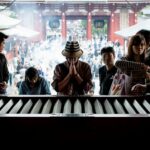
But spend time in the countries of East Asia — China, Hong Kong, Japan, Mongolia, North and South Korea, and Taiwan — and you will find families burning incense before an ancestor’s grave or visiting a Buddhist temple on a holiday. You will witness a Shinto shrine receiving thousands of visitors at New Year or a Korean Christian congregation filling a high-rise sanctuary on Sunday.
Reporting on East Asia can quickly run aground, however, when journalists import categories developed elsewhere and assume that religion works the same way in Beijing, Seoul, Taipei or Tokyo as it does in London, Lagos or Los Angeles (and, of course, it operates differently in these places too).
In much of East Asia, people may participate in Buddhist, Daoist, Confucian, Shinto or local ritual traditions without claiming an exclusive religious identity. Someone may say they have “no religion” while venerating ancestors, visiting temples, making offerings or consulting a religious specialist.
This guide, part of a new series from ReligionLink focusing on different regions in global religion reporting, provides background, resources, relevant stories and sources to help journalists understand East Asia’s religious institutions, communities, histories and political contexts.
Background and Resources
“East Asia” is a useful geographical shorthand, but it should not obscure enormous differences among societies. Here’s a breakdown of key countries in the region:
China
Religion in the People’s Republic of China exists within a highly regulated political system. The state officially recognizes five religions: Buddhism, Daoism, Islam, Protestantism and Catholicism. Religious organizations are expected to register within state-approved structures, and the Chinese Communist Party and government exercise extensive control over religious institutions and personnel.
At the same time, the Chinese religious landscape is considerably broader, involving various forms of popular religion, practices related to ancestors, qigong, spirit practices and other forms of ritual life complicate any simple division between “religious” and “nonreligious.”
The country’s official position should be approached critically, as the Chinese government emphasizes freedom of religious belief officially while also stressing state management, national unity, social stability and the principle that religions should be independent of foreign control. This can take the form of regulation and repression at times.
For journalists, that means reporting should distinguish between what Chinese law and officials say, what religious institutions relate and what people actually experience.
China’s policies toward Tibetan Buddhism, Uyghur Muslims, Protestant house churches, Catholic communities and other groups raise questions about the linkages between ethnicity, nationalism, human rights and state power. Human Rights Watch and the U.S. Commission on International Religious Freedom provide useful documentation, although reporters should understand the institutional perspective and methodology of each organization rather than treating any one report as definitive.
Japan
In Japan, Shinto and Buddhism remain deeply embedded in Japanese cultural and ritual life, while Christianity and newer religious movements have also played important roles.
On the one hand, Shinto, broadly speaking, encompasses traditions surrounding kami, which, according to the eighth-century Shinto chronicle Nihon Shoki, include upwards of 8 million spirits or deities associated with particular places, natural features, ancestors or other forms of sacred presence.
Buddhism, on the other hand, arrived from the Asian mainland in the sixth century and developed alongside, rather than simply replacing, existing practices like Shinto. At first, Buddhist tradition seemed a threat to Shinto practitioners. But over centuries, the two became deeply entangled, as Shinto proved adaptable and Buddhist temples came to be built alongside, or include, Shinto shrines within their precincts.
Such is the case in the famous Nara Park complex, which houses the massive Tōdai-ji temple and Kōfuku-ji as well as prominent Shinto sites like Kasuga Taisha. This is due to the fact that during the Nara period (710–794), Japan practiced shinbutsu-shūgō, a deep fusion where local Shinto kami and Buddhist figures were viewed as complementary or different manifestations of the same universal truth.
That is, until the Meiji Restoration when, in 1868, the government passed laws to separate Shinto from Buddhism (shinbutsu bunri) to promote a national state religion.
Nonetheless, today, Shinto practices may accompany New Year celebrations, visits to shrines, purification rituals and ceremonies surrounding birth. Buddhist institutions are particularly prominent in funerals, memorial rites and relationships with the dead. Because Shinto focuses on the living world, nature, and birth — and even views death as a state of spiritual impurity (kegare) — most modern Japanese families hold Buddhist funerals instead of Shinto ones.
There are other religious traditions in Japan as well. For example, “after the arrival of Francis Xavier in Japan in 1549, Christianity spread rapidly in Japan by European missionaries” and, despite the banning and severe persecution of Christianity, communities survived – including in places such as Nagasaki and the surrounding islands, where communities of so-called “Hidden Christians” maintained forms of Christian practice through centuries of prohibition. There are also Catholic, Protestant and Orthodox communities alongside newer evangelical and charismatic movements across Japan’s urban centers.
Japan is also home to a remarkable array of new religious movements, from large organizations such as Soka Gakkai — a Nichiren Buddhist tradition that focuses on the development of world peace through the spread of Buddhist humanism and been heavily involved in Japanese and global politics — to groups that have attracted far less international attention, such as Happy Science and other Japanese-founded religious movements that have developed their own distinctive cosmologies, rituals and institutions.
Islam is increasingly part of the country’s religious landscape as well. Japan’s Muslim population has grown substantially over the past several decades, driven largely by migration for work, study and family formation. A 2025 estimate by Waseda University professor emeritus Hirofumi Tanada put the number of Muslims living in Japan at roughly 420,000 at the end of 2024, including an estimated 55,000 Japanese Muslims. There are now more than 160 mosques across the country and an increasing infrastructure catering to culinary, sartorial and other daily needs.
Yet relatively few Japanese people describe religion as central to their lives. Pew’s 2024 research found that 42% of Japanese adults identified as having no religion, while 46% identified as Buddhist. At the same time, the distinction between religious identity and participation in rituals can be fluid.
North Korea
North Korea presents a fundamentally different set of reporting challenges.
Independent access to religious communities is extremely limited, and reliable contemporary data are scarce. Reporters should therefore be especially cautious with numerical claims about religious affiliation, underground religious communities, or state policy. Accounts from defectors, international organizations, governments and advocacy groups can provide important evidence, but their provenance and limitations should be made clear.
To accurately report on this region, journalists must account for the important role of Juche (also known as Kimilsungism-Kimjongilism) as well. As the country’s sole state-recognized religio-political philosophy, Juche operates less like a standard political theory and more like a dominant mythos with theocratic characteristics.
While officially promoting state atheism, Juche functions sociologically as a religion in North Korea, as it uniquely blends Marxist-Leninist language with Confucian hierarchy, fierce nationalism and a cult of personality that deifies Kim Jong-un and his predecessors.
Some demographic indexes go so far as to classify Juche as the world’s 10th largest religion, accounting for roughly 19-20 million adherents within the state. Such estimations should be treated with extreme caution.
But because the regime demands absolute devotion to the monolithic belief system of the Kim family, independent religious practices are treated as existential, anti-state threats. Thus, when analyzing claims about underground Christian networks or shamanic practices, reporters must remain keenly aware of how the state enforces compliance not merely out of political control, but out of a strict intolerance for competing spiritual or ideological authorities.
South Korea
South Korea has one of East Asia’s most institutionally visible Christian populations, alongside substantial Buddhist communities and a large population with no formal religious affiliation.
Pew Research Center’s 2024 report found that 52% of South Korean adults identified as religiously unaffiliated, 14% as Buddhist and roughly one-third as Christian. Christianity cannot be reduced to one political position or social constituency, and Korean Protestantism encompasses a wide range of theological and political orientations.
The same report also detailed the Korean American diaspora, which has a significant Christian contingent, constituting some 59% of Koreans in the U.S.
Religion in South Korea is also closely connected to modern history, democratization, education, politics, nationalism, migration and social movements.
For historical comparisons, Gallup Korea’s long-running surveys are particularly useful. Its 2021 survey, the sixth major national study in a series beginning in 1984, provides data on religious affiliation and attitudes across several decades, showing a significant rise in the non-religious population compared to previous years.
Taiwan
Taiwan is another rich religious landscape with plenty of statistics for reporters to dig into.
Buddhism, Daoism, popular religion, ancestor veneration, Mazu pilgrimage, folk practices, Christianity and newer religious movements all form part of the landscape. Pew’s research found that 27% of Taiwanese adults identified as religiously unaffiliated, while 28% identified as Buddhist and another 24% as Daoist.
To help keep track of it all, the Taiwanese government maintains unusually detailed information on religious organizations, temples, churches and religious foundations. The Ministry of the Interior’s religious statistics and Taiwan Religious Culture Map can be useful starting points for identifying institutions and understanding the country’s religious infrastructure.
Most religious practices in Taiwan, including Buddhism, Taoism and different folk traditions, trace their origins to mainland China and many believers regularly visit ancestral temples in China to honor shared deities like Mazu and Guandi. The Chinese government uses these historical and cultural bridge to influence public opinion and political attitudes in Taiwan.
The German media outlet Deutsche Welle (DW) reported on Chinese religious influence, noting that ties between certain temple leaders and opposition figures create openings for external pressure.
The Taiwanese government monitors such interference in religious groups in order to protect national security and some local religious communities host civil defense and informational events inside temples to counter what they see as foreign influence.
Tips & Suggestions
Covering religion in East Asia spans a wide range of topics, including political repression and state control, new religious movements, the “spiritual-but-not-religious” demographic, pushback against proselytization, declining temple attendance, corruption, scandals and beyond.
To help you navigate such a wide range of topics, here are some best practices and general guidelines for finding and following stories in East Asia:
1. Don’t equate “no religion” with “no religious practice”
In its 2023 survey of Hong Kong, Japan, South Korea and Taiwan, substantial shares of people identified as religiously unaffiliated even while participating in practices commonly understood as “religious” elsewhere. For example, Pew Research Center found that 27% of Taiwanese adults, 42% of Japanese adults, 52% of South Koreans and 61% of adults in Hong Kong said they had no religion.
While religion may be surprisingly difficult to see in the data, many people in these same societies report participating in practices such as venerating ancestors and local spirits. A Japanese person may visit a Shinto shrine at New Year and still say they have no religion. A Taiwanese family may maintain an ancestral altar, participate in a Mazu pilgrimage and identify as Buddhist, Daoist, neither or some combination of the three. A Chinese citizen may participate in temple rituals without belonging to an officially recognized religious organization. A Korean may attend church while also drawing on Confucian traditions that they would not necessarily describe as religious.
To underscore this point, China presents an additional challenge. The Chinese term zongjiao (宗教), usually translated as “religion,” is often associated with formal, institutionalized traditions rather than “traditional Asian forms of spirituality” according to Pew.
That means survey questions about whether someone “has a religion” may miss forms of ritual, devotion and popular practice that people themselves do not classify in those terms. Pew’s research on China consequently distinguishes formal religious affiliation from a much broader landscape of beliefs and practices.
For reporters, it means asking what people do before assuming you know what they believe. Pose questions such as:
- What religious or spiritual practices do you participate in?
- What happens in your family during major festivals?
- Do you visit temples, shrines or churches?
- What role do ancestors play in your family’s life?
- Would you describe any of those practices as religious?
You might also ask questions of the numbers themselves: Who counted whom, using what definition, at what point in time, and for what purpose?
2. Learn the vocabulary
As mentioned above, words such as zongjiao in Chinese, shūkyō in Japanese and jonggyo in Korean are often translated as “religion,” but the categories do not necessarily map neatly onto the English word.
Likewise, “Buddhist,” “Daoist,” “Shinto,” “Confucian,” “folk religion” and “spiritual” can carry different meanings in different contexts.
Ask your sources what the relevant term means to them rather than assuming the English translation settles the question.
3. Distinguish institutions from individual communities
A national religious association, denomination, temple network or government-recognized body is not necessarily representative of everyone who participates in that tradition.
This is especially important in China, where the relationship between religious institutions and the state is itself an important part of the story. China’s five officially recognized religions — Buddhism, Catholicism, Daoism, Islam and Protestantism — operate through state-regulated structures, while religious activity outside those structures can occupy different legal and political positions.
A government-approved Buddhist association, a local temple, a monk, a lay practitioner and an unregistered religious group may have very different perspectives on an issue or a topic you are covering.
4. State and civil society
In China, the government is tightening its oversight of religious institutions while promoting what it calls the “Sinicization” of religion. Christian congregations, Tibetan Buddhists, Uyghur Muslims, Daoists and practitioners of popular religion encounter the state in very different ways — some experiencing repression and state-sponsored persecution.
In Taiwan, temples and religious organizations are woven into civil society and public life as the island navigates an increasingly consequential relationship with Beijing.
In South Korea, churches remain major social and political institutions even as religious affiliation declines and the country becomes more religiously unaffiliated.
In Japan, Shinto shrines and Buddhist temples remain deeply embedded in public culture even though many Japanese people describe themselves as having no religion.
These developments intersect with some of the biggest stories in the region, such as Chinese nationalism and state power, Taiwan’s democracy and cross-Strait tensions, South Korea’s political polarization and demographic decline, Japan’s aging population and debates over national identity as well as the movement of people, money and ideas across East Asia.
Just as in other contexts, question how religion — even if it appears at first peripheral to the story — intersects with broader headlines or trends in politics, culture, economics, technology or society.
Recent Stories and Newswriting
- Listen “Persecuted Chinese religious leader finds refuge in the U.S.,” from NPR on Sept. 19, 2026.
- Read “Lawyer for China’s Zion Church seeks resettlement help while transiting through Taiwan,” from the Associated Press on Sept. 8, 2026.
- Read “South Korea’s Unification Church leader Hak Ja Han sentenced to 2 years for corruption,” from Religion News Service on Sept. 1, 2026.
- Read “Faith, recoded: Japan’s temples are disappearing. Is Buddhism?” from Japan Today on Aug. 30, 2026.
- Read “South Korea’s anti-faith fandango,” from The Washington Times on Aug. 26, 2026 (Commentary).
- Read “Fact Check: Japan did not ban mosques – its constitution guarantees religious freedom,” from Reuters on Aug. 24, 2026.
- Read “Why Our Dog Was Given A Taiwanese Traditional Pet Funeral,” from Religion Unplugged on Aug. 24, 2026.
- Watch “Why Does the Xi Jinping Administration Advocate the “Sinicization” of Religion?” from PBS News on Aug. 18, 2026.
- Read “A look at the history and beliefs behind Japan’s controversial shrine to the war dead,” from the Associated Press on Aug. 14, 2026.
- Read “British bishop calls new PM to bat for jailed Catholic Hong Kong activist Jimmy Lai,” from Crux on Aug. 11, 2026.
- Read “Don’t Forget to Feed the Hungry Ghosts: Taiwan’s Ghost Month Explained,” from CommonWealth Magazine on Aug. 11, 2026.
- Read “Emerging anti‑immigration sentiment in Japan obscures a surprising history of strategic engagement with Islam,” from The Conversation on Aug. 11, 2026 (Analysis).
- Read “Japan’s empty temples seek new ways to survive,” from Deutsche Welle on Aug. 9, 2026.
- Read “Are Singaporeans losing faith, or just dropping the labels?” from South China Morning Post on Aug. 2, 2026.
- Read “The Fate of China’s Muslims,” from the Los Angeles Review of Books on July 30, 2026.
- Read “A centuries-old festival in Japan brings Shinto traditions and towering floats to the streets,” from the Associated Press on July 19, 2026.
- Read “America’s leading Asian allies pummel freedom of religion,” from The Washington Times on July 10, 2026.
- Read “How South Korean Buddhists are trying to stay relevant,” from The Economist on July 9, 2026.
- Read “South Korean Buddhism tests ‘hip’ boundaries in bid for Gen Z appeal,” from the Japan Times on July 7, 2026.
- Read “China Frees Pastor Detained in Crackdown on Religion After Trump’s Urging,” from The New York Times on July 5, 2026.
- Read “WEA joins Korean church bodies opposing civil code bill over religious freedom concerns,” from Christian Daily on July 2, 2026.
- Read “Japan top court upholds order to dissolve Unification Church,” from the Japan Times on June 23, 2026.
- Read “The Transnational Trade of Thai Buddhist Amulets in China and Hong Kong,” from Religioscope on June 17, 2026 (Analysis).
- Read “Democracy Under Heaven: Taiwan’s Religious Politics in the Shadow of Communism,” from Providence on June 10, 2026 (Analysis).
- Read “Gods, Garrisons, and Governance: Resilience on Taiwan’s Nangan Island,” from Religioscope on June 8, 2026 (Analysis).
- Read “Rethinking North Korea: Inside The Christian Roots Of A Political Cult,” from Religion Unplugged on May 29, 2026.
- Read “Korea’s teens drift from religion, Buddhism hit hardest,” from the Korea Herald on May 15, 2026.
- Read “US must address China’s escalating war on religion,” from The Hill on May 13, 2026 (Commentary).
- Read “Ratio of senior Catholic priests nearly double in 10 years,” from Korea Herald on May 3, 2026.
- Read “North Korea’s complex relationship with its Christian past,” from PRRI’s The World on April 24, 2026.
- Read “Why Korea’s new religion bill is rattling Protestant churches,” from the Korea Times on April 17, 2026.
- Read “The Surprising Source of North Korea’s Enduring Power,” from The Wall Street Journal on April 10, 2026.
- Read “The Evangelical Roots of North Korea’s Kim Family,” from Christianity Today on April 2, 2026.
- Read “Buddhism’s Recent Decline in East Asia,” from Pew Research Center on March 11, 2026 (Analysis).
- Read “Japanese cardinal says a ‘polite persecution’ faces Christians in Japan,” from Crux on Feb. 28, 2026.
- Read “Why Did Buddhism Decline in Asia?” from The Diplomat on Feb. 18, 2026 (Commentary).
- Watch “How China uses religion for political influence in Taiwan,” from Deutsche Welle on Feb. 13, 2026.
- Listen “Jimmy Lai’s Faith Matters More Than The Headlines Admit,” from Religion Unplugged on Dec. 19, 2025.
- Read “North Korea claims victory in ‘war on religion’” from Deutsche Welle on Nov. 28, 2025.
- Read “China courts Taiwanese worshippers in religious charm offensive, study shows,” from Reuters on Oct. 23, 2025.
- Read “4 facts about religion and diversity in Taiwan,” from Pew Research Center on July 29, 2024 (Analysis).
- Read “In secular Japan, what draws so many to temples and shrines? Stamp collecting and tradition,” from the Associated Press on Oct. 5, 2023.
Experts and Sources
-
Barbara R. Ambros
Barbara R. Ambros is a professor in East Asian Religions in the Department of Religious Studies at the University of North Carolina at Chapel Hill. Her research on Japanese Religions has focused on gender studies, human-animal relationships and place.
-
Jason Ānanda Josephson Storm
Jason Ānanda Josephson Storm is a religion professor Williams College, who is particularly useful for reporters who need to understand why Western assumptions about “religion” can be misleading in Japan. His research examines how categories such as religion, science and superstition were constructed in modern Japan and how those categories shaped Shinto and Buddhist traditions there.
-
Asia-Pacific Institute for Broadcasting Development (AIBD)
Regional inter-governmental organization working in electronic media development with countries of the United Nations Economic and Social Commission for Asia and the Pacific (UN-ESCAP). Focuses on topics including globalization, cultural diversity, technology, public service broadcasting, peace journalism and conflict resolution, women’s and gender issues and HIV/AIDS. Hosted by the Government of Malaysia. Members in the Middle East, Asia and the Pacific. Affiliate members around the world.
-
Buddhist Compassion Relief Tzu Chi Foundation
Buddhist Compassion Relief Tzu Chi Foundation is a Taiwanese international humanitarian NGO with a branch in the U.S. that delivers medical aid, disaster relief and environmental support programs.
-
Nanlai Cao
Nanlai Cao is a sociocultural anthropologist at City University of Hong Kong who has conducted extensive ethnographic research on contemporary Chinese Christianity, particularly in Wenzhou. His work is especially useful for reporters interested in how religion operates at the level of neighborhoods, businesses, families and everyday life rather than simply through national policy. He also works on Chinese religious communities and globalization.
-
Carnegie Endowment for International Peace’s China Program
The China Program of the Carnegie Endowment for International Peace in Washington, D.C., hosted “China’s Olympian Challenge: Can Beijing Deliver on Its Promises?” on Oct. 11, 2007. It is the oldest international affairs think tank in the United States. Email via the website.
-
Catholic Tokyo International Center
The Catholic Tokyo International Center supports Japan’s international Catholic community.
-
Chung-Hwa Institute of Buddhist Studies
Chung-Hwa Institute of Buddhist Studies, located in New Taipei City, Taiwan, concentrates on being a global advocate for the academic study and research of Chinese Buddhism. It is part of the Dharma Drum Mountain World Center for Buddhist Education.
-
Jeyoul Choi
Jeyoul Choi is a lecturer at the University of Florida, who researched the religious experience of Korean Protestants as global and transnational agents who shape the religious landscape of both Korea and the United States.
-
Fairbank Center for Chinese Studies
The Fairbank Center for Chinese Studies has a rich history of scholarship on China.
-
Janet Gyatso
Janet Gyatso is a specialist in Buddhist studies and author of multiple books, including Being Human in a Buddhist World: An Intellectual History of Medicine in Early Modern Tibet (2015).
-
Chenxing Han
Chenxing Han is the author of Be the Refuge: Raising the Voices of Asian American Buddhists and studied chaplaincy at the Institute of Buddhist Studies in Berkeley, California. Contact Han via her website, or her publisher’s email is [email protected].
-
Japan Theravada Buddhist Association
Japan Theravada Buddhist Association is an organization in Tokyo that provides resources on Theravada Buddhism such as meditation, prayer, history and traditions.
-
Jewish Community of Japan
The Jewish Community of Japan provides a center for Japan’s Jewish population. It hosts regular Shabbat and holiday services, kosher dining and educational services. It is based in Tokyo.
-
Karrie Koesel
Karrie Koesel is an associate professor of political science at the University of Notre Dame. She specializes in Russian and Chinese politics and the intersection between politics and religion.
-
Korean Emerging Ministries Office
The Korean Emerging Ministries Office is part of the Presbyterian Mission Agency. It works to increase the population of Korean American Presbyterians. The Rev. Dr. Sun Bai Kim is the association for Korean Ministries.
-
Korean Orthodox Church
Includes a historical background of Orthodoxy in Korea as well as links and contact information on The Orthodox Metropolis of Korea and its parishes.
-
Benedetta Lomi
Benedetta Lomi is a professor of religion at Bristol University, who focuses on Japanese Buddhism, its material, and visual culture, with particular emphasis on the performative, healing and transformative dimensions of Buddhist rituals, scriptures and objects.
-
Richard Madsen
Richard Madsen is a distinguished professor emeritus of sociology at UC San Diego and director of the Fudan-UC Center on Contemporary China, Madsen is a foundational scholar of Chinese religion and society, with a particular focus on Chinese Catholics and Taiwanese religion.
-
Nichiren Buddhist International Center
Nichiren Buddhist International Center, based in Hayward, Calif., is a U.S. headquarters for the Nichiren Shu Buddhist order. The worldwide headquarters is in Tokyo, Japan. The website offers a global directory for temples around the world.
-
Orthodoxy in China: Orthodox Fellowship of All Saints of China
Offers news and information and historical information on Orthodoxy practice in China.
-
Purdue University’s Center on Religion and Chinese Society
Center on Religion and Chinese Society at Purdue University in West Lafayette, Ind., opened in 2008, focuses on religions in Chinese societies, including mainland China, Taiwan, Hong Kong, and other Chinese communities. Fenggang Yang is the director.
-
Ian Reader
Ian Reader is a scholar of contemporary Japanese religion at Lancaster University whose work includes pilgrimage, Japanese Buddhism, new religious movements and religious practice in Asia.
-
Stanford China Program
The Stanford China Program, begun in 2007 and part of the Walter H. Shorenstein Asia-Pacific Research Center at Stanford, includes conferences, exchanges and fieldwork in China. Program director is Jean C. Oi.
-
State Administration for Religious Affairs of P.R.C
Government portal. Hosts the China Religion Culture Communication Association, Center for Religious Research of China, China Religious Culture Publisher and China Religion Journal. Available in Mandarin only.
-
Taiwan Association for Religious Studies
The Taiwan Association for Religious Studies is the first religious association in Taiwan. It was established on April 18, 1999, by a group of scholars and academics. The association researches mainstream and folk religions in Taiwan and publishes monthly newsletters.
-
Kaitlyn Ugoretz
Kaitlyn Ugoretz is an anthropologist of religion and the associate editor of publications at the Nanzan Institute for Religion and Culture, including the Japanese Journal of Religious Studies. Ugoretz specializes in contemporary Japanese religion, globalization, technology and media. Her digital ethnographic research focuses on the globalization of Shinto and the development of transnational online Shinto communities.
-
University of Southern California’s U.S.-China Institute
The University of Southern California’s U.S.-China Institute supports research, teaching and outreach to improve understanding of U.S.-China relations.
-
U.S. Commission on International Religious Freedom
The U.S. Commission on International Religious Freedom (USCIRF) is an independent, bipartisan commission created by the 1998 International Religious Freedom Act (IRFA) that monitors religious freedom violations abroad and makes policy recommendations to the U.S. federal government.
-
World Association of Buddhism
The World Association of Buddhism works to re-establish and confirm the philosophies and practices of Buddhism across the globe. The organization provides educational resources such as classes, projects and histories on Buddhism.
-
Fenggang Yang
Fenggang Yang directs the Center on Religion and Chinese Society at Purdue University. He is the author or co-author of more than a dozen books, including Religion in China: Survival and Revival Under Communist Rule. He is also an expert in Asian immigration and Eastern religions.