


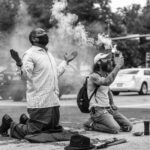
On a hot and humid September afternoon in Glendale, Arizona, mourners streamed into State Farm Stadium for the memorial of conservative activist Charlie Kirk. Banners of the cross hung beside American flags, and gospel anthems mixed with political slogans from the stage. What some saw as a service of remembrance was also something else: a rallying cry where grief and faith were harnessed to a political narrative, casting Kirk as a martyr and his death as proof of values under siege.
Religion has always been woven into American politics, but that mix has turned sharper in recent years. With faith language cropping up at campaign rallies, on protest signs and at crime scenes, the U.S. is facing a new era where religious identification, political loyalty and violence often overlap.
In this edition of ReligionLink, we provide background, tips, stories, sources and other resources for reporters to better cover the confluence of religion and political violence in the months and years ahead.
Background and resources
Researchers disagree about whether religion is a root cause of political violence or a marker that political actors use instrumentally. On the one hand, some research shows how sacred meanings, millenarian narratives and religious communities can motivate and legitimize violence — especially when movements frame their struggle as cosmic or existential. For example, sociologist Mark Juergensmeyer — a leading scholar of religious violence — argues that while religion does not inherently cause violence, it provides a framework and justification for it through theology, ritual and networks of transnational exchange, often framing conflicts as a “cosmic war” between good and evil, a notion that demonizes opponents and allows for absolutist violence.
On the other hand, other research emphasizes structural, strategic and opportunistic explanations: Political exclusion, state weakness, economic grievances and manipulation shape violent outcomes more than theology per se. For example, some view violence between Christian and Muslim groups in Nigeria, while frequently framed as religious, as primarily driven by deeply rooted structural issues that various actors exploit. Competition for political power, economic resources and control over state institutions fuels those conflicts, with ethnic and religious identities often used to mobilize support and mask underlying causes.
For more on the different lines of argumentation about religion and political violence, see the following books, articles and essays:
- Stathis Kalyvas, The Logic of Violence in Civil War (2006).
- Jonathan Fox, “The salience of religious issues in ethnic conflicts: A large‐N study” (2007).
- Scott Atran, “The Devoted Actor: Unconditional Commitment and Intractable Conflict across Cultures” (2016).
- Mark Juergensmeyer, Terror in the Mind of God (fourth edition, 2017).
- Miles T. Armaly, David T. Buckley and Adam M. Enders, “Christian Nationalism and Political Violence: Victimhood, Racial Identity, Conspiracy, and Support for the Capitol Attacks” (2022).
Tips and suggestions
Reporters covering this terrain have to sort myth from motive, asking how faith is being invoked as belief, political tool or rallying cry. In your reporting, make clear what is known and what is speculation. Be precise with labels such as “Christian nationalist” or “extremist,” and show the diversity inside religious groups rather than treating them as monolithic blocs.
Context matters. Christian nationalism in the U.S. has deep roots, for example, but it is not the only story. Hate crimes against Muslim, Jewish and Sikh communities, threats to Black churches and attacks on Catholic and evangelical communities are equally part of the picture. Reporting should show how power, race and geography shape which groups are vulnerable and which wield influence.
It is also important to cast the potent mix of religion and political violence in the U.S. within broader currents of conflict around the globe. How does America’s present cycle of violence compare to events in other parts of the world? What might we learn from historical examples — in the U.S. or abroad?
Accuracy also means balance. Do not only quote the loudest voices. Include dissenters within religious communities and the people directly harmed by violence or rhetoric. Look at consequences, not just claims. And resist the temptation to dramatize. Straightforward, documented facts do more to reveal the stakes than overheated language.
This is a topic where history, law, theology and politics collide. It rewards preparation — turning to experts in fields you are unfamiliar with, knowing the Scripture or tradition being cited, understanding free speech and hate-crime statutes and asking tough but respectful questions of sources.
Done well, reporting on religion and political violence can clarify rather than inflame and can help audiences see what is really driving events rather than simply the slogans attached to them.
Related reporting, commentary and analysis
Stories
- Read “Poilievre claims Christians ‘may be the number 1’ victims of hate-based violence,” from CBC News on Sept. 29, 2025.
- Read “Black Clergy and Christians Grapple with Charlie Kirk’s Legacy,” from Christianity Today on Sept. 26, 2025.
- Read “Black pastors say Charlie Kirk is not a martyr, while decrying racism and political violence,” from The Associated Press on Sept. 24, 2025.
- Listen to “Gov. Cox of Utah looked to his Mormon faith in hopes of keeping the state free of political violence. Is that possible now?” from National Public Radio on Sept. 20, 2025.
- Read “At prayer vigils for Charlie Kirk, supporters are called to political and spiritual fight,” from Religion News Service on Sept. 16, 2025.
- Watch “Religious leaders denounce political violence at Stockton vigil after Charlie Kirk killing,” from The Stockton Record on Sept. 16, 2025.
- Read “Rev William Barber condemns Kirk’s killing and warns against using religion to ‘sanctify wrong,’” from The Guardian on Sept. 15, 2025.
- Read “Idaho faith leaders unite against political violence, call for peace and compassion,” from CBS 2 Idaho News on Sept. 13, 2025.
- Read “How do we end a pattern of political violence?” from Religion News Service on Sept. 12, 2025.
- Read “Minnesota religious leaders call for end to political violence,” from MPR News on June 20, 2025.
- Read “We Should Not Be Shocked that the Alleged Minnesota Shooter’s Christian School is Connected to Political Violence,” from Religion Dispatches on June 17, 2025.
- Read “Sri Lanka’s New Mass Grave Reveals Failure Of ‘Peace’ Through Violence,” from Religion Unplugged on June 14, 2025.
- Read “The Rise of Antisemitism and Political Violence in the U.S.” from Time on June 2, 2025.
- Read “India: How polarized politics affects West Bengal violence,” from Deutsche Welle on April 22, 2025.
- Read “Monks Behaving Badly: Explaining Buddhist Violence in Asia,” from the MIT Press Reader in spring 2025.
- Read “Poll: More religious Americans support the use of political violence,” from Religion News Service on Oct. 25, 2023.
Analysis and commentary
- Read “As American As Guns, Baseball, And Political Violence,” from Patheos on Sept. 26, 2025 (Commentary).
- Read “Death, politics and the private faith of public power,” from Baptist News Global on Sept. 24, 2025 (Commentary).
- Read “Faith in a Time of Fear prayer vigil to end political violence,” from Marquette Today on Sept. 17, 2025 (Commentary).
- Read “Making Mortals Into Martyrs,” from Patheos on Sept. 16, 2025 (Analysis).
- Read “Churches must resist polarization as a path to reducing violence,” from Religion News Service on Sept. 15, 2025 (Commentary).
- Read “Prophecy, Trump, and the Justification of Political Violence,” from Public Religion Research Institute on June 18, 2025 (Analysis).
- Read “How Anti-Abortion Violence is Political Violence,” from Rewire News Group on June 18, 2025 (Commentary).
- Read “Spiritual warfare and the roots of political violence,” from The Contrarian on June 17, 2025 (Analysis).
- Read “An 18th-century rebellion for liberty, equality and freedom − not in France or the United States, but Ireland,” from The Conversation on May 20, 2025 (Analysis).
- Read “Salafi Muslims are going into politics instead of trying to change the world through religious education or jihadi violence,” from The Conversation on April 1, 2025 (Analysis).
- Read “What the Catholic Church says about political violence and the need to forgive – even would-be assassins,” from The Conversation on July 18, 2024 (Analysis).
- Read “After Political Violence, How Do We Love Our Enemies?” from Sojourners on July 16, 2024 (Commentary).
Sources
-
Nawara Aboud
Nawara Aboud is a graduate researcher at University College, Oxford. Her expertise revolves around the politics of ethnicity, violent conflict, peace-building and post-conflict transformation. In particular, her research focuses on the political trajectories that countries take in the aftermath of civil wars and the economic, social and political dynamics that drive them.
-
Scott Atran
Scott Atran is an anthropologist who experiments on ways scientists and ordinary people categorize and reason about nature, on the cognitive and evolutionary psychology of religion, and on limits of rational choice in political and cultural conflict. Atran has conducted fieldwork around the world, where he has interviewed the leadership and members of insurgent and extremist groups. He is also the author of In Gods We Trust: The Evolutionary Landscape of Religion.
-
Zarina Baber
Zarina Baber is assistant commissioner and chief transformation officer of Minnesota IT Services in the Office of Transformation and Strategy Delivery under Gov. Timothy Walz. Baber was chairwoman of the Muslim Caucus of America where, along with the rest of the organization, she worked to boost political engagement within the Muslim community during election season around issues such as immigration, gun violence and racism.
-
David G. Bromley
David G. Bromley is a professor of sociology at Virginia Commonwealth University. He specializes in sociology of religion, with a particular emphasis on the study of New Religious Movements and the anti-cult movement. He is co-editor of Cults, Religion, and Violence.
-
Angana P. Chatterji
Angana P. Chatterji is an anthropologist and founding chair of the Political Conflict, Gender and People’s Rights Initiative at the Center for Race and Gender at the University of California, Berkeley. Chatterji’s recent scholarship is focused on political violence as well as prejudicial citizenship and Hindu nationalism in India. Chatterji has served on human rights commissions and offered expert testimony, including at the United Nations, European Parliament, United Kingdom Parliament and U.S. Congress and commissions.
-
Grisel D’Elena
Grisel D’Elena is a Ph.D. candidate in the department of international relations at Florida International University’s School of International and Public Affairs, where she is an adjunct professor. She has performed fieldwork abroad with U.N. officials, refugee coalition members and ethnic minorities, specifically in Southeast Asia, where she began to investigate the Rohingya Muslim ethnic group in Myanmar.
-
Melissa Florer-Bixler
Melissa Florer-Bixler is a doctoral student at Duke Divinity School, with a degree from Princeton Theological Seminary. A Voices columnist for the Christian Century, she has also written for Sojourners, Geez, Anabaptist Witness, Image Journal, Faith&Leadership and Anabaptist Vision. She is the author of How to Have an Enemy: Righteous Anger and the Work of Peace. She speaks on various issues of justice, including organizing memorials for lynching victims, preaching in the Raleigh women’s prison and working toward a just peace in Palestine. Arrange an interview through the contact form on her website.
-
Jonathan Fox
Jonathan Fox is the Yehuda Avner Professor of Religion and Politics, director of the Religion and State project and a senior research fellow at Bar-Ilan University’s Begin-Sadat Center for Strategic Studies. His research investigates the impact of religion on domestic conflict, terrorism, international intervention and international relations.
-
Carolyn Gallaher
Carolyn Gallaher is a professor in the School of International Service at American University in Washington, D.C. Her research is on organized violence by nonstate actors and urban politics.
-
Jeremy Ginges
Jeremy Ginges is a professor in behavioral science at the London School of Economics and Political Science. His research focuses on two related problems: How do humans decide whether to cooperate across cultural boundaries, and why do people sacrifice everything (their own lives, the lives of loved ones) for an abstract cause like nation or god?
-
Christian van Gorder
Christian van Gorder is an associate professor of religion at Baylor University who teaches world religions. He is the author of multiple books, including Islam, Peace, and Social Justice and (as co-author) Jews and Christians Together: An Invitation to Mutual Respect.
-
Thomas Blom Hansen
Thomas Blom Hansen is a professor in South Asian studies and anthropology at Stanford University. His fieldwork was done during the 1990s when conflicts between Hindu militants and Muslims defined national agendas and produced frequent violent clashes in the streets. Out of this work came two books: The Saffron Wave: Democracy and Hindu Nationalism in Modern India and Wages of Violence: Naming and Identity in Postcolonial Bombay.
-
Mark Juergensmeyer
Mark Juergensmeyer is Distinguished Professor Emeritus of Global Studies, Sociology, and affiliate of Religious Studies at the University of California, Santa Barbara, where he was the founding director of the Global and International Studies Program and the Orfalea Center for Global and International Studies. He is an expert on religious violence, conflict resolution and South Asian religion and politics and has published more than 300 articles and 30 books, including Terror in the Mind of God: The Global Rise of Religious Violence, and his most recent book is Why God Needs War and War Needs God.
-
Stathis N. Kalyvas
Stathis N. Kalyvas is Gladstone Professor of Government and fellow of All Souls College at Oxford. Until 2018 he was Arnold Wolfers Professor of Political Science at Yale University, where he founded and directed the Program on Order, Conflict, and Violence and co-directed the Hellenic Studies Program. In 2019 he founded the T. E. Lawrence Program on Conflict and Violence at All Souls College.
-
Paul C.H. Lim
Paul C.H. Lim is a professor of humanities at the University of Florida with a particular focus on the consequences of Christian theology. In April 2021, Lim spoke on a Vanderbilt Divinity School panel about the histories of racialized and gendered violence.
-
Rachel Monaghan
Rachel Monaghan is professor of peace and conflict at the Centre for Trust, Peace and Social Relations at Coventry University in the U.K. She studies political violence, with a particular interest in paramilitary conflict in Northern Ireland.
-
Arie Perliger
Arie Perliger is a security studies professor at the University of Massachusetts Lowell. His research interests include political violence and extremism.
-
Michael Pfleger
The Rev. Michael Pfleger is senior pastor for the Faith Community of St. Sabina in Chicago. He helps lead an annual march against gun violence.
-
Vasundhara Sirnate
Vasundhara Sirnate is a political scientist and journalist whose research includes counterinsurgency in South Asia, insurgent group dynamics in India, gender justice and societal violence. She was formerly the chief coordinator of research at the Hindu Centre for Politics and Public Policy and a nonresident fellow with the Atlantic Council in Washington, D.C.
-
Eugene Sutton
The Rt. Rev. Eugene Sutton is assistant bishop in the Episcopal Diocese of Washington. He was one of three conveners of Bishops United Against Gun Violence, an ad hoc group of around 60 Episcopal leaders. Contact is through Allen Fitzpatrick.
Relevant ReligionLink content
- Crime and perception: Religion, public safety and the 2024 elections
- Faith and Politics: Keeping it simple while complicating the narratives
- Culture wars renewed: 25 sources ahead of the 2024 elections
- ‘One victim is too many’: Reporting on domestic violence and religion
- Covering religious responses to gun violence
- When gun violence invades sacred spaces